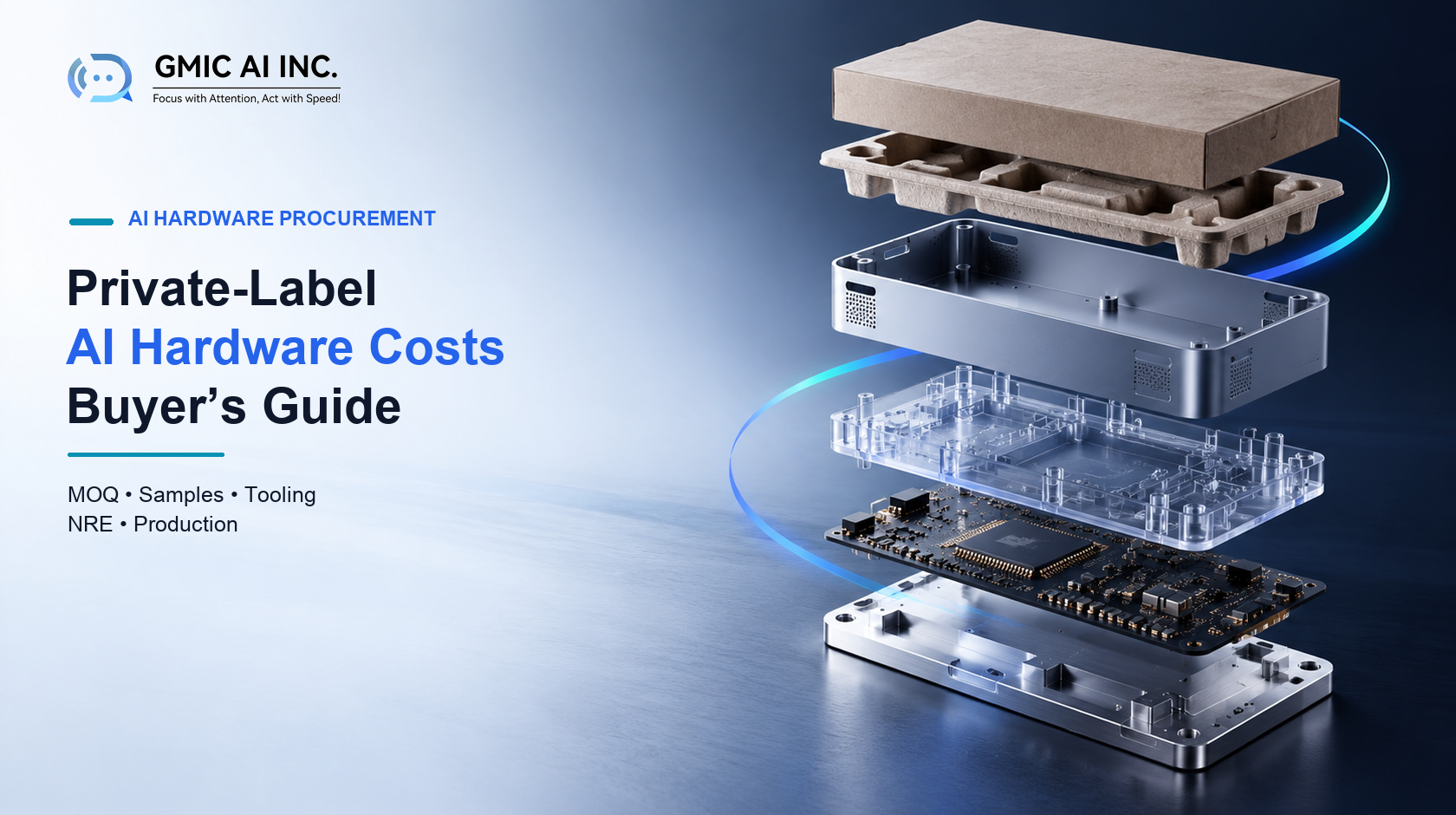
Private-label AI hardware costs should be separated into one-time engineering costs, reusable assets, compliance work and recurring production costs. A low unit price can be misleading when the quotation excludes firmware integration, tooling, packaging, certification support, quality fixtures or post-launch changes.
There is no universal MOQ or price for an AI voice device. The answer depends on how much of an existing platform remains unchanged, the forecast volume, component supply, enclosure and packaging customization, software scope, target markets and acceptance criteria.
In brief: Ask every supplier to quote the same configuration and divide the proposal into samples, NRE, tooling, certification, packaging, recurring unit cost and optional services. Record what the customer owns, what can be reused and which changes trigger a new charge.
Explore GMIC AI hardware ODM/OEM services or discuss a private-label hardware project.
What Does “Private Label” Mean in AI Hardware?
Private-label hardware usually starts with an existing device platform that is adapted for another company’s brand and workflow. The scope can range from a logo and package change to a new enclosure, firmware behavior, mobile application, cloud integration and certification program.
Three commercial models are commonly discussed:
| Model | Typical starting point | Relative customization |
|---|---|---|
| White label | Existing finished product | Brand, packaging and limited configuration |
| Private label | Existing platform with customer-specific options | Branding, firmware, accessories, packaging and selected hardware changes |
| ODM development | Reference architecture or product concept | Deeper electronics, enclosure, firmware and manufacturing changes |
These labels are not standardized contract terms. The statement of work matters more than the label. Two suppliers can call a project “private label” while including very different deliverables.
For a broader comparison, see GMIC’s AI hardware ODM/OEM guide.
The Seven Cost Buckets in a Private-Label Quote
| Cost bucket | What it may include | One-time or recurring? |
|---|---|---|
| Samples and evaluation units | Stock units, configured samples, shipping and test accessories | Usually one-time per evaluation round |
| NRE | Engineering, project management, firmware, mechanical and integration work | Usually one-time, but changes can add NRE |
| Tooling and fixtures | Molds, jigs, test fixtures, programming and assembly aids | One-time plus maintenance or replacement |
| Compliance | Pre-scan, lab testing, reports, filings, documentation and retests | Initial plus change-driven retesting |
| Packaging and brand assets | Artwork, inserts, labels, cartons and print setup | Setup plus recurring materials |
| Production units | BOM, assembly, testing, yield allowance and factory margin | Recurring |
| Logistics and lifecycle | Freight, duties, warehousing, warranty, repairs and component changes | Recurring or event-driven |
A useful quote places every line into one of these buckets and states the assumptions behind it.
Samples: Stock, Configured and Engineering Builds
“Sample” can describe several different things:
- Stock sample: an existing product used to evaluate industrial design and basic operation.
- Configured sample: existing hardware with approved settings, branding or firmware options.
- Engineering sample: a modified or prototype build used to validate new requirements.
- Pilot unit: a production-intent device assembled with the planned process and quality controls.
The price increases as the sample becomes less like stock production. A one-off enclosure, manual rework, special firmware build, expedited components and engineering support should not be compared with the future mass-production unit price.
Before ordering samples, document what the evaluation is expected to prove: audio capture, battery life, BLE behavior, enclosure size, integration, packaging, regulatory feasibility or user workflow. Otherwise teams can spend money on samples that were never designed to answer the decision.
MOQ: Why the Minimum Order Quantity Changes
MOQ is the smallest commercial quantity a supplier will accept for a defined configuration and price. It is influenced by more than factory preference.
Common drivers include:
- Component and module purchasing quantities.
- PCB fabrication and assembly panel economics.
- Enclosure color, coating and material batch sizes.
- Logo process and print setup.
- Packaging, inserts and accessory minimums.
- Line setup, programming and test time.
- Forecast confidence and inventory risk.
- Whether the platform is already in active production.
A low MOQ may carry a higher unit price or require the buyer to fund excess custom material. A higher MOQ may reduce conversion cost but increases inventory, cash and forecast risk.
Ask for a price ladder at several volumes and identify which parts are purchased specifically for the order. Also ask whether the MOQ applies to the total program, each color, each package version or each destination market.
NRE: What Non-Recurring Engineering Should Cover
NRE is the one-time engineering work needed to create and validate the agreed configuration. It may include:
- Requirements review and architecture decisions.
- Schematic, PCB and component changes.
- Mechanical and acoustic engineering.
- Firmware configuration or development.
- Mobile, SDK or cloud integration support.
- Prototype builds and debugging.
- Verification planning and reports.
- Manufacturing documentation and test development.
- Program management and supplier coordination.
NRE should be tied to deliverables and milestones, not presented as an unexplained fee. The proposal should state how many revision cycles are included, what constitutes a change request and what happens if a requirement cannot be met.
Questions to ask about NRE
- Which requirements and design versions does the fee cover?
- Are prototype units and components included or separate?
- How many firmware, PCB and enclosure revisions are included?
- Which test reports, source files and manufacturing packages are delivered?
- Who owns newly created design files, code and fixtures?
- Which background platform IP remains the supplier’s property?
- Is any NRE credited against a production order?
- What event creates additional NRE?
These are commercial and legal questions as well as engineering questions. Contract language should be reviewed by qualified counsel.
Tooling: Molds Are Only One Line Item
Hardware tooling can include:
- Injection molds and inserts.
- Soft tools for low-volume enclosure trials.
- CNC or forming fixtures.
- Assembly jigs and alignment fixtures.
- Programming fixtures.
- Electrical functional-test fixtures.
- Acoustic test couplers and reference fixtures.
- Packaging dies and print plates.
- Cosmetic inspection samples and color standards.
For every tool, record ownership, physical location, maintenance responsibility, expected life, storage, access rights and the process for transfer or disposal. A tooling payment does not automatically answer these questions.
Tooling should begin only after the relevant geometry and manufacturing assumptions are stable enough. Cutting a mold before antenna, microphone port, button, gasket or battery decisions are verified can turn a schedule shortcut into an expensive revision.
GMIC’s custom hardware enclosure design and hardware prototype validation pages explain the connection between product geometry and validation.
Certification and Market Access Costs
Target markets and radio technologies can materially change the compliance plan. A product may need consideration of radio, EMC, electrical safety, battery transport, materials, labeling, accessibility or sector-specific rules. The exact obligations depend on the product and where it will be sold.
In the United States, the FCC’s equipment-authorization framework includes Certification and Supplier’s Declaration of Conformity procedures for applicable RF devices. The FCC explains that RF devices subject to authorization must meet technical requirements before marketing or importation; see the official FCC equipment-authorization information.
For the European Union, the European Commission’s 2022 Blue Guide explains the product-rules framework, conformity assessment, CE marking and market surveillance. For Great Britain, current requirements should be checked against the official UKCA and CE market guidance.
These sources do not determine the requirements for a specific product. Engage qualified compliance specialists and accredited laboratories for the intended configuration and markets.
Ask whether the quote includes
- Regulatory assessment and standards list.
- Pre-compliance testing.
- Accredited laboratory fees.
- Sample preparation and shipping.
- Technical documentation.
- Filing, registration or local representative fees.
- Label and manual review.
- Retest allowance.
- Support for questions from a laboratory or authority.
Changing an antenna, radio module, enclosure, power supply or other relevant design element may affect existing evidence. Define a change-control process before production.
Packaging and Branding Costs
Branding can appear inexpensive until every physical and digital touchpoint is listed. Scope may include:
- Product logo method and location.
- Color, texture and surface finish.
- Retail or industrial packaging.
- Inserts, quick-start guide and warranty material.
- Regulatory labels and serial numbers.
- Accessories, cable, charger and carry case.
- Firmware device name and identifiers.
- Mobile-app graphics or onboarding.
- Carton labeling and regional language variants.
Ask which artwork format, color reference, approval sample and print tolerance are required. A logo change may also require a different mold insert, laser program, pad-print setup or inspection standard.
The Recurring Unit Price
The production unit price can include:
- Bill of materials.
- PCB fabrication and assembly.
- Enclosure and cosmetic processing.
- Final assembly.
- Firmware programming and key injection.
- Functional, RF and acoustic testing.
- Packaging and included accessories.
- Yield allowance and factory overhead.
Confirm the commercial term used in the quote and what is excluded. Freight, duties, insurance, local taxes, warehousing and importer responsibilities may sit outside the quoted unit price.
Do not compare two unit prices until the configuration, quality plan, packaging, accessories, warranty and commercial terms match.
Software, Cloud and Integration Costs
An AI device often depends on software outside the physical product. Possible costs include:
- BLE or Wi-Fi protocol work.
- SDK and API integration.
- Device identity and provisioning.
- Secure key handling.
- Mobile-app customization.
- OTA infrastructure and signed updates.
- Audio upload, buffering and retry behavior.
- Cloud usage and third-party licenses.
- Model licensing or per-device activation.
- Logs, support tools and fleet management.
Separate development cost from ongoing subscription or usage cost. Define which services continue if the supplier relationship ends and how devices can be supported through their intended life.
See GMIC’s private-label voice AI hardware and white-label AI voice recorder pages for related platform options.
Hidden Costs That Commonly Appear Later
Requirement changes
A change that looks small in a slide deck can affect PCB layout, enclosure, firmware, test fixtures, compliance evidence and packaging at the same time.
Component lifecycle changes
Allocation, end-of-life notices or approved substitutions can create redesign and validation work. Agree on notification and approval rules.
Low first-pass yield
Rework, retest and scrap affect capacity and cost. Define test limits and failure ownership before ramp.
Localization
Different languages, labels, manuals, packaging and market-specific accessories can create separate stock-keeping units and minimums.
Warranty and returns
Return analysis, replacement inventory, repair, freight and data-handling processes need an owner and budget.
Post-launch updates
Security, compatibility and service changes can continue after shipment. Define the included support period and update mechanism.
How to Compare Supplier Quotations
Use a normalization table so every supplier answers the same questions.
| Field | Supplier A | Supplier B | Supplier C |
|---|---|---|---|
| Exact hardware and firmware baseline | |||
| Sample type and quantity | |||
| NRE deliverables and revision limits | |||
| Tooling list and ownership | |||
| MOQ by variant | |||
| Unit price by volume | |||
| Included test and quality controls | |||
| Certification assumptions | |||
| Packaging and accessories | |||
| Software and license fees | |||
| Commercial term and payment milestones | |||
| Warranty and lifecycle support |
Record exclusions and open assumptions beside the price. The cheapest complete bid can be different from the lowest visible unit price.
A Stage-Gated Budgeting Approach
Stage 1: Feasibility
Use stock or configured samples to validate the core workflow, audio path, size, connectivity and platform fit.
Stage 2: Requirements and quotation
Freeze the target configuration far enough to request comparable NRE, tooling, compliance and volume pricing.
Stage 3: Engineering validation
Build and test design-intent hardware. Resolve architecture and high-risk performance issues before final tooling.
Stage 4: Design and production validation
Verify production-intent design, manufacturing process, fixtures, quality limits, packaging and compliance samples.
Stage 5: Production and lifecycle
Track yield, field failures, component changes, firmware releases and warranty cost against the original assumptions.
For planning across these stages, see GMIC’s voice AI hardware project planning guide and EVT/DVT/PVT manufacturing support.
Frequently Asked Questions
What is a typical MOQ for private-label AI hardware?
There is no universal MOQ. It depends on platform maturity, custom materials, component and packaging minimums, factory setup and commercial risk. Request MOQ and unit price by configuration and volume rather than relying on a category-wide number.
Is NRE refundable?
That depends on the commercial agreement. Some suppliers may credit defined engineering fees against a later order; others do not. The proposal should state the rule explicitly.
Does the unit price include certification?
Often it does not. Certification work is commonly quoted separately because cost depends on markets, radio configuration, standards, laboratories and retesting. Confirm the exact inclusions.
Who owns private-label tooling?
Ownership is determined by the contract, not only by who paid an invoice. Specify ownership, location, maintenance, access, transfer and end-of-life handling.
Can an existing certification be reused?
Possibly, but not automatically. The answer depends on the authorization, product changes, radio implementation, responsible party and target market. Obtain a product-specific assessment from qualified compliance professionals.
When should a custom enclosure be tooled?
After critical mechanical, acoustic, antenna, thermal, battery and assembly assumptions are sufficiently validated. Earlier soft tooling or machining may be useful for learning before committing to final production tooling.
Price the Complete Program, Not Only the Device
Private-label AI hardware economics are a combination of engineering scope, reusable platform value, production volume, compliance obligations, brand customization and lifecycle responsibility.
The strongest quotation is not necessarily the one with the fewest lines. It is the one that makes assumptions, ownership, deliverables, exclusions and change conditions clear enough for the buyer to forecast total program cost.
Contact GMIC to review a private-label voice AI hardware requirement, or explore AI hardware ODM/OEM services.