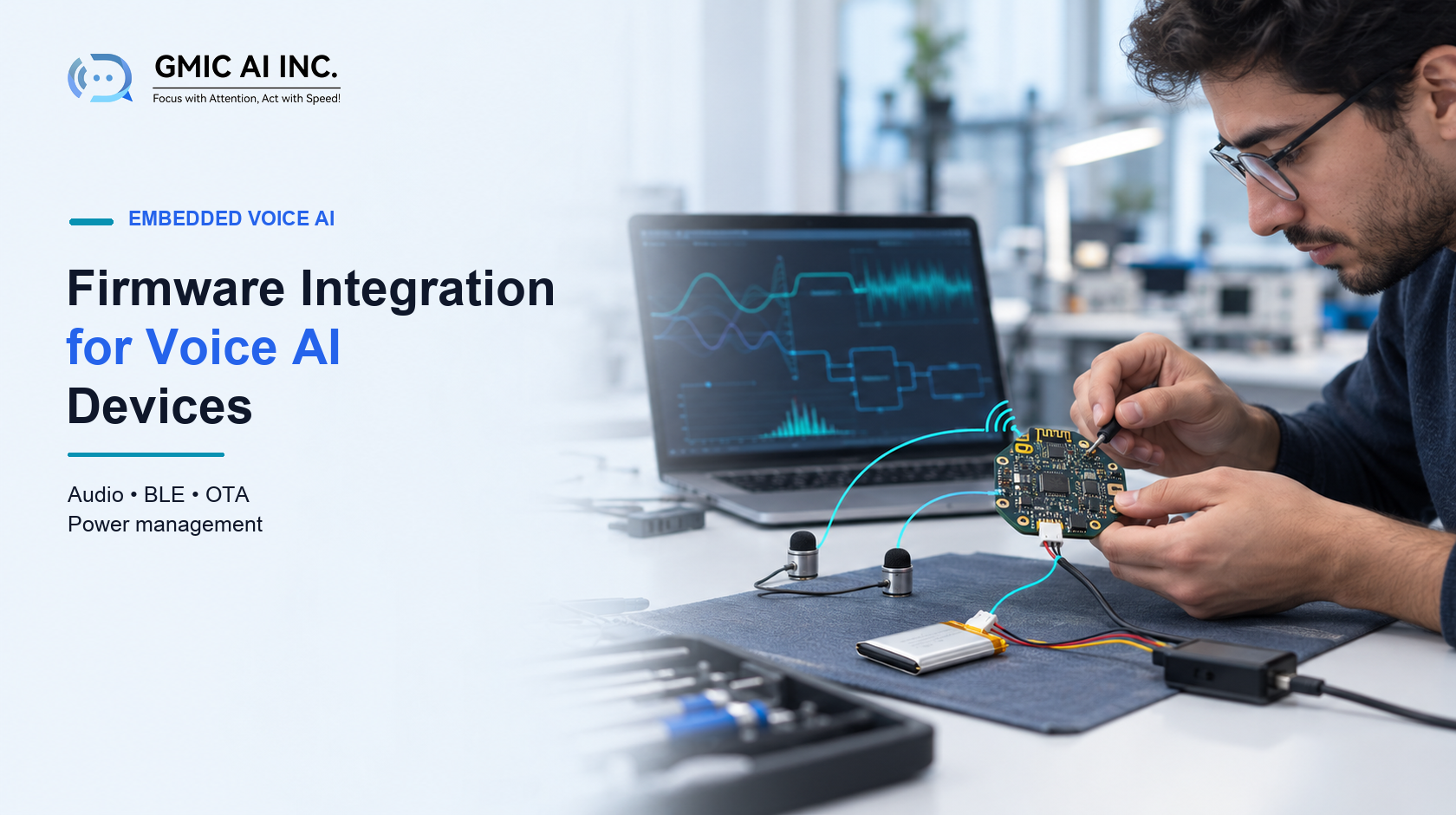
Firmware integration for voice AI devices is the engineering layer that connects microphones, codecs, DSP, storage, radios, mobile applications, cloud services and power states into one reliable product. A model demo can work on a development board while the final device still fails because audio buffers overflow, BLE disconnects, timestamps drift, updates cannot recover or sleep states lose data.
In brief: Define interfaces and failure behavior before writing device-specific code. Version the hardware, firmware, protocol and model together. Test the complete path from button or wake event through capture, transfer, processing, feedback, storage and recovery on production-intent hardware.
Explore GMIC firmware integration services or discuss a voice-device project.
What Firmware Owns in a Voice AI Device
Firmware may be responsible for:
- Boot, device identity and hardware initialization.
- Microphone, codec, I²S, PDM or TDM drivers.
- Audio buffering, timestamps and sample-format conversion.
- DSP control and parameter loading.
- Wake-word, VAD or on-device inference scheduling.
- Buttons, LEDs, haptics and user-state feedback.
- BLE, Wi-Fi, USB or cellular transport.
- Local storage, encryption and upload recovery.
- Battery measurement, charging and power states.
- Secure boot, signed updates and rollback behavior.
- Diagnostics, crash records and manufacturing tests.
The boundaries should be explicit. A mobile application may own account login but firmware may own device identity. A cloud service may generate the note but firmware must preserve the audio segment and encounter metadata until transfer succeeds.
Start With an Interface Contract
Before integration, document each boundary.
| Interface | Define before implementation |
|---|---|
| Audio | Channels, rate, bit depth, frame size, clock, latency and overflow behavior |
| DSP/model | Input format, parameters, memory, compute, version and fallback |
| BLE/Wi-Fi | Roles, services, messages, security, retry and compatibility |
| Storage | File format, naming, encryption, retention and full-storage behavior |
| Mobile/cloud | Authentication, metadata, acknowledgements, idempotency and errors |
| OTA | Signing, compatibility, staging, recovery, rollback and status reporting |
| Power | State machine, wake sources, current budget and data preservation |
| Diagnostics | Log levels, counters, privacy boundaries and retrieval method |
Treat the contract as a versioned artifact. Undocumented assumptions become integration defects.
Audio Capture and Buffering
The audio path begins with clock configuration and driver behavior, not the AI model. Confirm microphone channel order, polarity, gain, sample rate and DMA behavior. Measure dropped frames and timestamp continuity under worst-case concurrent load.
Define what happens when:
- The processor cannot consume a frame in time.
- Storage or wireless transfer is temporarily blocked.
- The microphone clock and host clock drift.
- Recording starts during another system event.
- A user pauses, cancels or immediately restarts.
- The device resets before an audio file is finalized.
Use bounded buffers and observable counters. Silent data loss is harder to diagnose than an explicit failure state.
See GMIC’s AI audio front end and AI DSP for voice devices guides.
BLE Is a Control Plane, Data Plane or Both
BLE works well for discovery, configuration, state, small messages and some data-transfer patterns. Audio throughput, latency and background behavior require product-specific testing.
Android’s official BLE overview describes central/peripheral and GATT client/server roles, and warns that sensitive data should use application-layer security. Define:
- Advertising and discovery behavior.
- Pairing, bonding and account ownership.
- GATT services, characteristics and permissions.
- Message framing, sequence numbers and acknowledgements.
- Reconnection and stale-session handling.
- Background-app behavior and OS permission changes.
- Multi-device and device-replacement workflows.
- App/firmware protocol compatibility.
Do not treat a successful laboratory connection as proof of field reliability. Test busy RF environments, phone models, operating-system versions, range limits and repeated reconnects.
Wi-Fi, Upload and Offline Recovery
For Wi-Fi or phone-mediated upload, separate capture success from transfer success. Store enough state to resume safely after power loss or network interruption.
A robust transfer design can include:
- Immutable recording or segment identifiers.
- Checksums and ordered segment numbers.
- Explicit server acknowledgement.
- Idempotent retry to prevent duplicates.
- Local deletion only after the defined confirmation.
- Backpressure when storage approaches its limit.
- Visible error and recovery feedback.
- Correct association with user, device and workflow metadata.
For local-first architectures, see offline voice AI hardware.
OTA Updates Need a Recovery Design
An OTA feature is incomplete if it only downloads and writes new firmware. Define authentication, compatibility, power-loss recovery, validation after boot and rollback policy.
Arm’s Platform Security guidance describes trusted boot and firmware-update requirements. MCUboot design documentation covers signed images and optional downgrade prevention using version or security counters.
Plan for:
- Signed firmware and protected verification keys.
- Product, hardware-revision and region compatibility.
- Sufficient staging space or dual-image strategy.
- Interrupted download and interrupted installation.
- Boot confirmation and automatic rollback.
- Authorized recovery and factory servicing.
- Update rollout, pause and cohort controls.
- Audit trail without exposing sensitive content.
Test low battery, unexpected reset, corrupted image, wrong image, full storage and loss of connectivity at every update stage.
Power Management Is a System State Machine
Battery life depends on how long each subsystem remains active and how often it wakes. Define named states such as shipping, off, deep sleep, advertising, connected idle, recording, processing, transferring, updating and fault recovery.
For each state, record:
- Active clocks and power rails.
- Wake sources and debounce behavior.
- Radio and storage activity.
- Audio continuity requirements.
- Expected current and maximum duration.
- Entry and exit conditions.
- Data that must be committed before sleep.
Measure current on target hardware across realistic workflows, not only a static sleep figure. A reconnect loop, noisy wake source or unclosed peripheral can dominate the daily energy budget.
Device Identity, Keys and Provisioning
Decide how every production unit receives its identity, credentials and configuration. Manufacturing processes may need secure programming, verification and traceability.
Questions include:
- Which identifiers are public, private or customer-specific?
- Where are keys generated, stored and rotated?
- Can debug interfaces expose secrets or production data?
- How is ownership transferred or reset?
- What happens when provisioning partially fails?
- Can the factory verify success without learning secret values?
Security architecture should be reviewed by qualified specialists for the product’s threat model.
Logging Without Creating a Privacy Problem
Useful diagnostics include reset reason, buffer overruns, radio state, update state, battery data, storage health and protocol errors. Logs should use timestamps, event codes and firmware versions.
Avoid recording unnecessary speech content, credentials or sensitive metadata. Define retention, access and export behavior. Use counters and redacted identifiers where they answer the engineering question.
Manufacturing and Service Firmware
Production needs controlled ways to program, test and release devices. Deliverables can include:
- Factory image and production image.
- Programming and key-injection procedure.
- Hardware self-test and fixture protocol.
- Audio, radio, sensor and power test commands.
- Serial-number and calibration flow.
- Pass/fail limits and software versions.
- Debug-lock procedure and verification.
- Repair, rework and return diagnostics.
Manufacturing commands should not remain as an undocumented security bypass in shipped devices.
Integration Test Matrix
| Area | Minimum failure cases |
|---|---|
| Audio | Overflow, clock drift, rapid start/stop, storage blocked |
| BLE | Pairing rejection, out-of-range, reconnect, phone restart |
| Upload | Packet loss, duplicate retry, reordered segments, expired token |
| Storage | Full media, corrupted file, interrupted finalization |
| OTA | Wrong image, bad signature, power loss, failed boot, rollback |
| Power | Low battery, unexpected wake, charger attach/remove, thermal limit |
| Identity | Failed provisioning, factory reset, ownership transfer |
| Concurrency | Recording during reconnect, upload, logging and user input |
Record hardware revision, firmware commit, configuration, mobile-app version, backend version and test data for every result.
Common Integration Failure Modes
- Audio and radio tasks compete without measured scheduling margins.
- Firmware and app teams change the protocol independently.
- Acknowledgement means “received” to one component and “processed” to another.
- Local files are deleted before durable backend confirmation.
- OTA rollback restores firmware but not compatible data structures.
- Debug logs change timing or fill storage.
- Power tests omit reconnect and failure loops.
- Manufacturing uses a different build or configuration from validation.
The remedy is not more informal debugging. It is versioned interfaces, reproducible tests and observable state transitions.
Firmware Integration Deliverables
A useful handoff may include:
- Architecture and state-machine diagrams.
- Driver and middleware source or documented binaries.
- Protocol and storage specifications.
- Build environment and configuration files.
- Bootloader, partition and OTA design.
- Security and provisioning assumptions.
- Test plans, automation and known limitations.
- Release notes and compatibility matrix.
- Factory programming and diagnostics package.
- Lifecycle ownership and update process.
Ownership and licensing should be agreed before implementation begins.
Frequently Asked Questions
Should voice audio stream over BLE?
It depends on throughput, latency, codec, power, phone support and reliability requirements. BLE may be ideal for control while another path handles audio, or it may support the full workflow when carefully designed and tested.
Does OTA require dual-bank flash?
Not universally. The update strategy depends on memory, bootloader and recovery requirements. The design must remain recoverable after interruption and reject unauthorized images.
How early should firmware integration start?
Interface and state-machine design should start during architecture. Driver bring-up begins with early hardware, while end-to-end failure testing continues through DVT and PVT.
What should be tested after a firmware change?
Use dependency and risk analysis. Changes to audio, power, radio, storage, bootloader or protocol can affect multiple workflows, so maintain automated regression plus targeted hardware tests.
Integrate the Whole Voice Workflow
Voice AI firmware is successful when the product captures complete audio, preserves identity and order, communicates state clearly, survives failures, updates securely and meets the energy budget.
GMIC supports firmware integration for AI devices, AI SDK integration and complete voice AI hardware programs. Contact GMIC to define the hardware–firmware–cloud boundary.